you’re exploring living systems

  • this work is only made possible because of so many other brilliant folks in the broader field who have so generously shared their own thinking.  what we offer here is simply a next layer for consideration, and of course what we hope might be something that someone else will continue to build on.  let knowledge and wisdom be free flowing so that we might find our way through.

  • this work didn't arrive fully formed. it grew through conversations, experiments, and the generosity of people willing to think and build alongside me. with fiona mckenzie and alice howard-vyse, back in 2021, and later on more peers, as we opened the door to systems leadership. lina patel, whose work with me on power in the system first planted the seed of the nested model. the systems practice framework continued to evolve from ever trying to answer, what do we do when we do systems thinking? in many collaborative conversations with anna rasalingam and of course my mentor prof. ray ison i was able to further unpack this. in the last few years, dana shen — co-creator, dear friend, and teacher — with whom i get to play and learn and build every day in our systems leadership program, where we have worked to bring all the bits into cohesion, along with all the peers in that program who bring the wisdom, experience and incredible questions that keep pushing the work forward.

    i also want to offer my deep gratitude to the land, skies and waters — from canada to australia and everything in between — that have held me, and taught me throughout my life. to First Nations peoples around the world, whose ways of seeing, knowing, being and doing are not supplementary to this work but foundational to it, the original systems thinkers. to the Anishinaabe, Waddawurrung and Kabi Kabi peoples in particular, whose Country i have been privileged to listen and learn from.Item description

  • Item descrii’ve worked  in, out and across complex systems for most of my career, this has provided me with wonderful opportunities to learn, be an ally and wayfind and sometimes stumble through these fascinating things we call human systems. i am so appreciative of the many humans that are doing their best. it was a special chance to meet seanna through the systems sanctuary program, as we got to know each other, we knew we had to find a way to continue to work together, and step by step, we finally found our way to the systems leadership program. it is very special to work with a trusted friend!

    i am also so grateful to all my family and friends, my Elders who have been role models and particularly my dear Chinese Grandparents. their love was always unconditional (as long as i got a good job and was paid well!) and they always had high expectations of me, - they assumed and expected me to do well! This has been most precious.

    i also want to acknowledge the Ngarrindjeri Nation, as i find my way home to language and culture, humbly walking the path of my ancestors, i feel strong, and i am glad to share this with others.

    ngapi tarnaulo kulyulaink-an ngang-el-ap wunyi yarnd-el-ap. nginti ngul!
    (i will never be ashamed of who i am and where i come from!)ption

    • the leadership centre, uk and their reports on systems leadership

    • systems leadership in practice: thematic insights from three public health case studies by charlotte bigland , david evans, richard bolden and maggie rae

    • leadership in the age of complexity by margaret wheatley and debbie frieze

    • the practice of systems leadership, the kings fund

    • systems leadership for sustainable development by lisa dreier, david nabarro and jane nelson, the harvard kennedy school

    • systems change and deep equity an interview with sheryl petty and mark leach, change elemental

    • systems leadership by global knowledge initiative for usaid

    • systems leadership by deborah ghate, jane lewis and david welbourn

    • nora bateson, small arcs of larger circlesption text goes here

    • the waters centre for systems thinking: habits of a systems thinker

    • the school for systems change: systems practices

    • prof. ray ison: systems practice

    • leyla acaroglu: systems practices

    • sonja blignaut: 3 habits of mind

    • systems sanctuary as tatiana fraser and rachel sinha: systems capabilities + feminist systems change framework

    • the inner development goals

    • the australian centre for social innovation

    • we also want to acknowledge and thank our colleagues who offered many conversations, insights and considerations which have deeply informed the development of the framework: grace o’hara, anna rasalingam, emma blomkamp, ray ison

    • and our dear systems sanctuary crew that first brought us together, and since then has been a space of deep conversation, stimulating questions, support and growth all around.  thank you alice howard-vyse, sam rye and euan black.

    • our initial development of roles in the system through the lens of ‘facilitating systems thinking’ as taught at the systems school

    • our colleagues fiona mckenzie @ orange compass, euan black @ tacsi, the team at the school of systems change, rachel sinha @ the systems studio

    • social change now by deepa iyer

    • a blog post by emma proud in linkedin

    • a comment offered by anna morgan on a linkedin post by adrian robke regarding deepa’s model

    Description text goes here

    • Ngarrindjeri Elders & leaders

    • First Nations leaders across the world

    • Robin Wall Kimmerer, Braiding Sweetgrass

    • Dr. Jennifer Grenz, Medicine Wheel for the planet

    • Nancy J. Turner, The Earth’s BlanketItem description

    • Ngarrindjeri Yarluwar Ruwi

    • animate & non- animate beings

    • empathetic multispecies design- daniel metcalfe

    • the sea change project-including craig foster

    • earth species project - asa raskin (co-founder)

    • way of the circle centre, jan beaver and martha lucierItem description

    • Pema Chodron

    • Jack Kornfield

    • Tara Brach

    • Thich Nhat Hanh

    • Bhikkhu Analayo

    • Shantideva

    • tricycle -the Buddhist Review

    • mind & life institute

    • center for humane technologyItem description

towards a theory of systems leadership

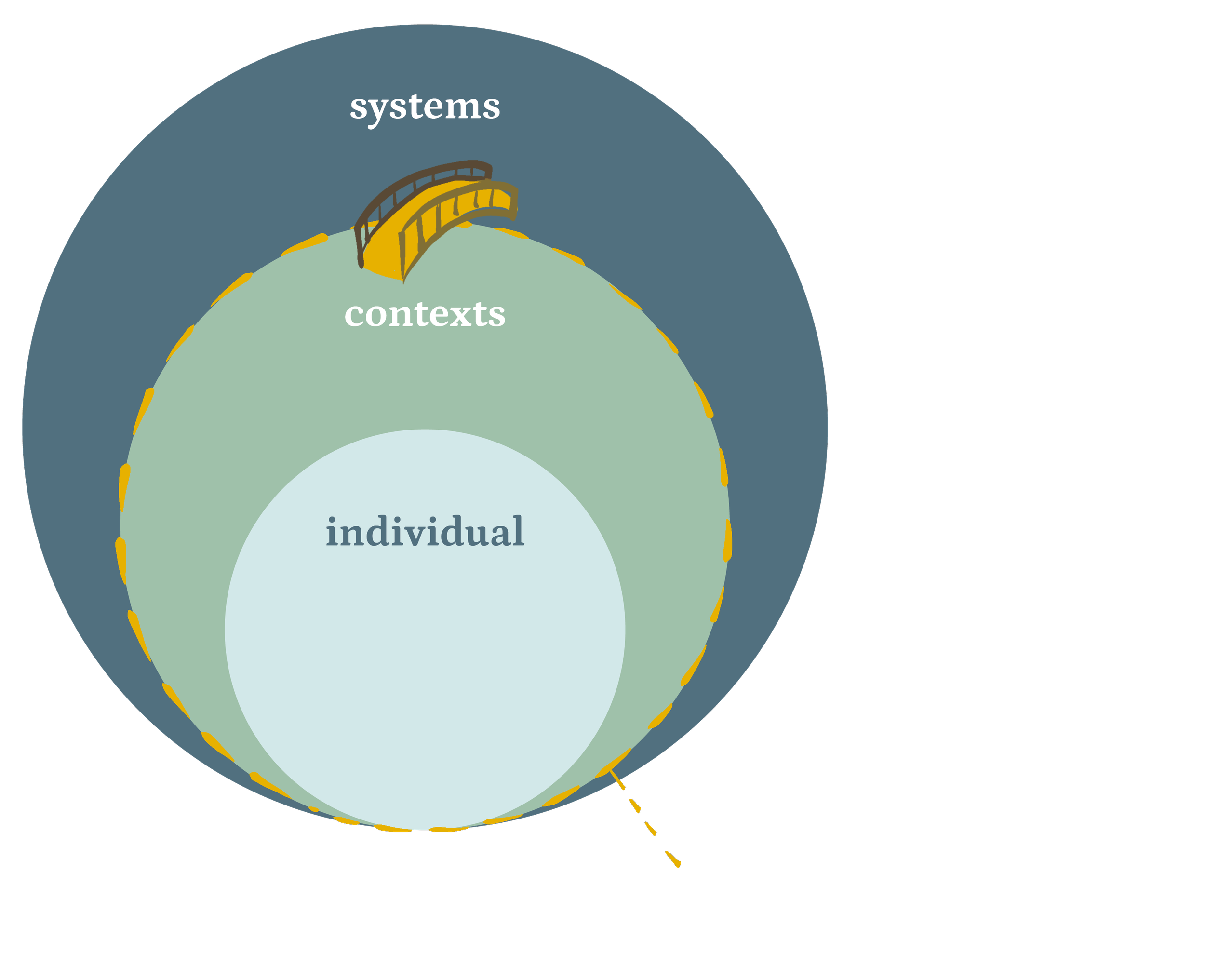
systems leadership as a nested system

we offer a theory of change that recognizes while systems leadership is collective in its outcome, it begins with each of us as individuals doing our own inner work. it’s nested and multi-layered - and here’s what’s crucial to understand: each level is contained within the next, not separate from it. the individual level sits within the contextual level, which sits within the systems level. they’re not three separate stages we move through linearly, but rather three interrelated dimensions that exist simultaneously.

The enabling conditions for this to scale to wide system reach is the recognition of mutuality, that the success of the whole depends on the contribution of individual parts and a holistic systems world view.

this nesting creates enabling relationships between the levels: individual work is necessary but not sufficient for contextual work - you need the inner development, but that alone won’t create change in your contexts. contextual work is necessary but not sufficient for systems leadership - you need people applying their capabilities in their local situations, but that alone won’t shift patterns across the whole system. the outcome at each level enables the possibility at the next level - individual development creates the foundation for contextual contribution, which creates the conditions for systems-level emergence.

starting with the deeply personal question of who we are and who we’re becoming, expanding into how we show up contextually in our communities and systems, and ultimately contributing to the conditions where systems leadership can emerge naturally across the whole. like a forest that grows through the individual health of each tree, root system, and mycorrhizal network, systems leadership emerges through the authentic development and contribution of each person, while remaining fundamentally dependent on the relationships and interdependence between all parts.