

an approach to systems leadership
here we share our work on systems leadership that has slowly been building over the last 10 years of our collective careers. this work is what we have on offer at the moment, in this time and place of history and cultural discombobulation, where most days we can't determine the way up or out, but simply try to feel into the first next step. what emerged was a question that asked,
what would it look like to nurture leadership that mirrors living systems themselves: seasonal, self-organizing, biodiverse, layered, betwixt and between, adaptive, and generative?

our work in systems leadership can be explored through different entry points. our thinking has been articulated in a conceptual framework for systems leadership, a systems practice framework, and a theory of change. we share those here as a introduction to our thinking, and begin with our worldview, which underpins all else.

a systems leadership worldview
a system is a web of interconnected relationships that intentionally extends beyond human-centered boundaries to include all beings—animate and non-animate—across multiple generations and timescales. these relationships are characterized by fundamental mutuality, where the wellbeing of each part is inherently connected to the wellbeing of all others. the system boundary recognizes that non-human beings possess inherent roles, wisdom, and contributions that exist independent of human assignment, operating together toward ending suffering and creating wellbeing for all.
systems leadership as a nested system
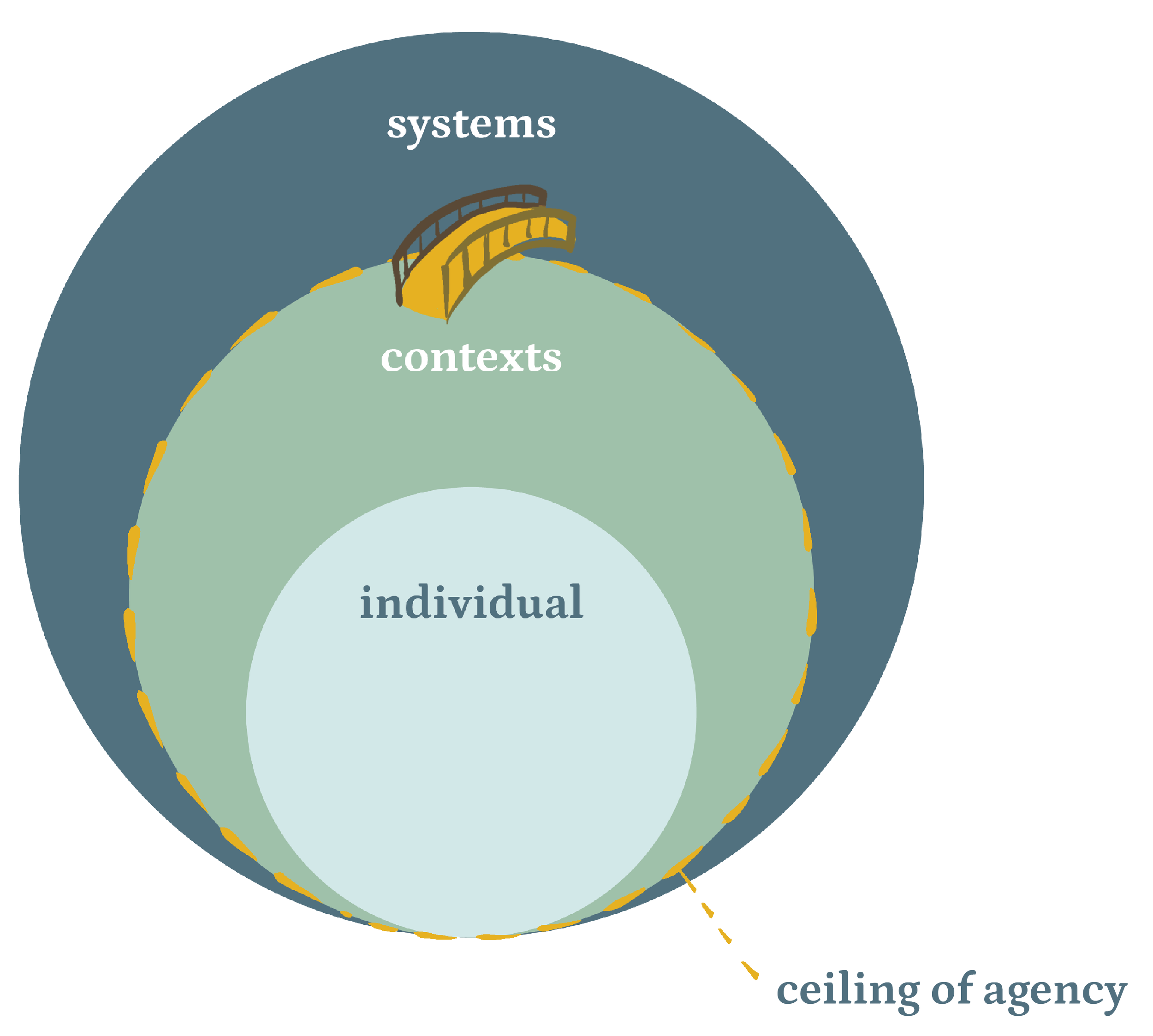
we understand systems leadership as something that plays out at three levels at once: the individual, the contexts we act within, and the wider system. each level sits inside the next. who we are shapes how we show up in our contexts, and what happens across many contexts shapes what becomes possible in the whole.
at the individual level, systems leadership lives in the capabilities each of us develops and draws on: the traits, values and beliefs, knowledge, skills and behaviours that shape who we are in the world. at the level of context, it lives in how we orient and respond to the systemic dynamics within our reach, the places where we can influence and be influenced. here we step into and out of roles as the moment requires. these contexts differ for each of us, and most of us move across several: a workplace, a community, a family.
at the systems level, systems leadership becomes an outcome in its own right. it is a changed system dynamic, a new pattern that emerges when many people, across places and levels of a system, are developing and applying their capabilities in their own contexts. this activation is collective, though not necessarily coordinated. no single person produces it.
read from the inside out, the circles trace a movement from the personal question of who we are and who we are becoming, toward the whole. each level enables the next. the capabilities we develop as individuals are the foundation for what we contribute in our contexts, and what many people contribute across their contexts creates the conditions for change across the system. each level is necessary, and none is sufficient on its own. inner development alone won't shift a context, and people acting well within their own contexts won't, by that alone, shift the patterns of a whole system.
read from the outside in, the circles show what holds each of us: the systems we belong to set the conditions for the contexts we act in, and those contexts influence who we can become. all three levels are present at the same time, in every moment of practice.

between the contextual and systems levels sits the enabling condition, shown in the diagram as a bridge. what allows the contributions of many people, across many contexts, to reach further into the system is the recognition of mutuality: that the success of the whole depends on the contribution of each of its parts.
this is the holistic systems worldview we began with, and here it becomes what lets us walk across the bridge. when we recognise that our wellbeing is bound up with the wellbeing of all others, human and beyond, our separate efforts begin to add up to something none of us could hold alone.
individual
individual
individuals are developing and harnessing systemic capabilities. each of us brings our own combination of them, drawn from our history, our experience, and how we are oriented to the world. some capabilities may come more readily than others, and all of them can be developed. the aim is to come into awareness of our own combination and grow it with intention. our systems practice framework sets out the focus areas and practices that support this.
contextual
contextual
leaders are orienting and responding to the systemic dynamics in their contexts. this asks us to connect with the reality of our system, its opportunities and its challenges, seeing what is as well as what ought to be. we combine our capabilities to take up systemic roles as they are needed. those roles shift from one context to another, and our relationship to them changes over the course of a life.
systems
systems
at this level, systems leadership is a phenomenon we come to recognise by its patterns. it is process-based, unfolding over time, and generative, sustaining itself as it grows.
emergent patterns and trends in systems leadership
self-organising. people step into roles as they see the needs of the system meet their capabilities, and step back when their contribution is complete. roles are taken up from within the system as needs appear.
seasonal. leadership emerges when the system requires it and recedes when it doesn't. like the seasons, it has its times, and a fallow period is part of the cycle.
biodiverse. those stepping into leadership are diverse in identity, experience, worldview, and ways of knowing, being and doing. as in any living ecosystem, that diversity is a source of resilience, and systems leadership takes many forms.
layered. it takes place across scales, levels, sub-systems and cultures at once: in a home as much as a school, in a region as much as a nation.
adaptive. it keeps evolving in response to feedback from the system, noticing what is shifting and adjusting in turn. donella meadows described this as learning to dance with systems.
betwixt and between. much of it happens in the in-between places, below the radar, without formal recognition or even a name, which is part of why it is easy to miss.
towards a theory of systems leadership
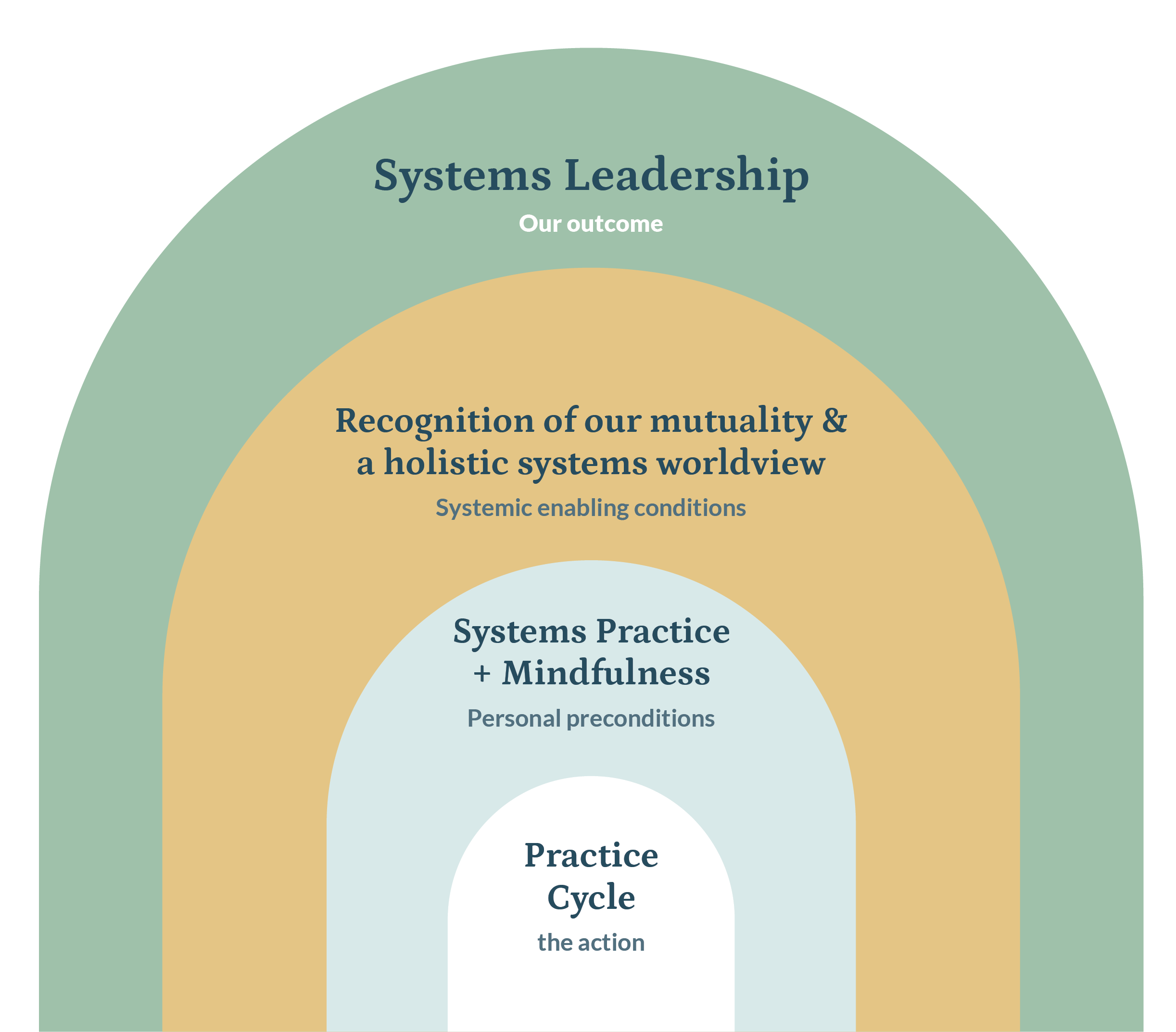
our theory of change traces how systems leadership becomes possible, from a single act of practice to a changed pattern across the whole. it reads from the centre outward.
practice cycle: the action
at the centre are the direct efforts we take as practitioners to strengthen our systemic capabilities: trying something, noticing how it went, and adapting. this is practice as a verb, repeated across our work and our lives, and it is where change in the practitioner begins.
systems practice and mindfulness: personal preconditions
practice needs something to practice with. the systems practice framework defines the scope of our work as systems leaders, the capabilities and levels we attend to. mindfulness sits alongside it, building the steadiness and attention that let us meet complexity, and its emotional weight, with clarity.
recognition of our mutuality and a holistic systems worldview: the systemic enabling condition
this is the worldview that guides us. recognising that the success of the whole depends on the contribution of each part is what lets individual practice connect to something larger than itself.
systems leadership: our outcome
systems leadership as an outcome is achieved when the collective agency and capability of the whole is enacted. it belongs to no one person, and emerges from the whole.
each layer develops from the one within it. practice builds the personal preconditions, those preconditions cultivate a shared worldview, and that worldview opens the way to collective systems leadership.